Mausoleum encounter
Pokemon Go: The Ultimate Beginner's Guide For Kindle Book Tips And Trick How to Become The Best Pokemon Trainer: This Kindle Book Will Answer Your Unsolved QuestionsMausoleum encounter is the decisive horror episode in the guide’s otherwise practical account of Pokémon GO. During a nighttime ride undertaken to find PokéStops and catch Pokémon, the player crosses from augmented-reality play into an apparently impossible physical conspiracy. The encounter begins with ordinary game incentives—a rich cluster of real-world locations and the rare appearance of Gengar—but descends through a mausoleum into a scene of corpses, hidden stairs, medical vessels, masked men, and a duplicate of the player. Its final reversal leaves the event suspended between supernatural experience, psychological disturbance, and deliberate uncertainty.
From Game Route to Forbidden Space
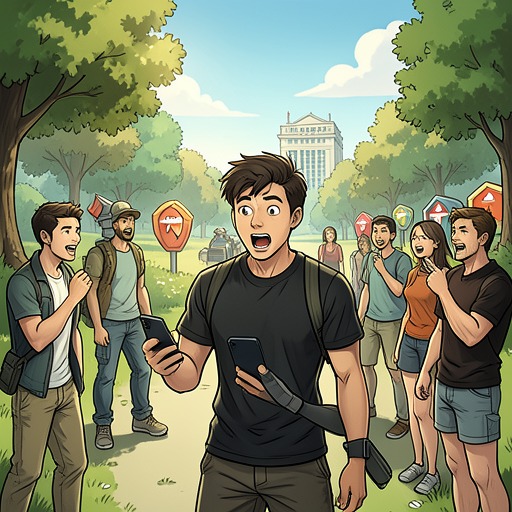
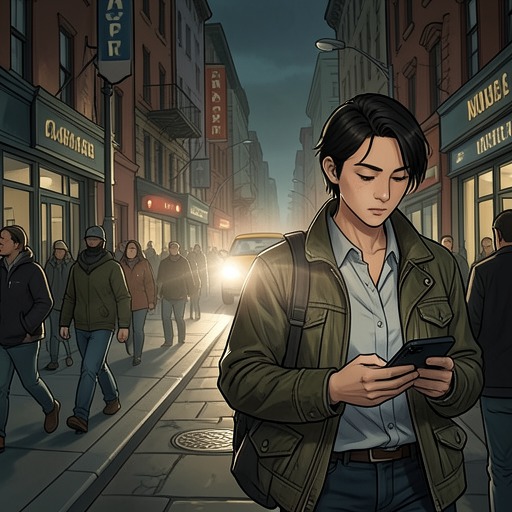
The episode grows out of the game’s location-based design. Pokémon GO turns real monuments into PokéStops, places where a player can spin a photographic disc and collect items, while the avatar’s movement depends on the player’s actual movement, GPS signal, internet connection, and location settings. The player follows that logic into the night on a bicycle, pursuing Pokémon and the dense concentration of PokéStops displayed by the augmented-reality map. What appears first as a gaming opportunity becomes a spatial lure: the map marks the cemetery as a rewarding “Gold mine,” while the physical setting carries the older meanings of death, burial, and restricted access.
The cemetery intensifies the contrast between play and place. The player has no inherent fear of cemeteries and says that he believes in the supernatural while also believing in mutual respect between the living world and the dead. He locks his bicycle at the entrance, takes out a flashlight, and moves among the gravestones collecting game rewards. Ghost-type Pokémon appear during the search, an occurrence that seems fitting within the game’s logic and gradually makes the cemetery feel as though it has been selected for the player. A gust of wind from a nearby storm supplies a possible ordinary explanation for the chill that passes through him, but the atmosphere has already shifted from recreational exploration to apprehension.
The Mausoleum and the Descent
The player reaches a section containing several small mausoleums, two medium-sized ones, and one especially prominent Large Mausoleum. The largest structure is described as an assertion of importance that continues beyond death, making it both a family monument and a conspicuous landmark. As the player enters this area, his phone begins producing notifications from every direction about ghost-type Pokémon. The concentration is greater than any he has previously seen in one place, and the cemetery seems to function simultaneously as a game node and as a Gothic enclosure.
The rare Gengar near the entrance of the Large Mausoleum provides the immediate reason to approach. Third-evolution Pokémon are presented as unusually rare, so the encounter promises an exceptional reward within the game. While attempting to catch Gengar, the player notices a narrow beam of light coming through the mausoleum door. He abandons the caution taught by parents, horror films, and friends, raises his flashlight, and walks inside. The act is a threshold crossing: the player is no longer merely using a phone to interpret a real place, but physically entering the site that the game has made attractive.
Inside, flaming lights hang from the ceiling, apparently still lit for a purpose. The player advances and sees the decaying corpses of a man and a woman. Behind the side associated with the husband, four steps are concealed. The architecture changes the encounter from a visible family tomb into a vertical passage toward concealed knowledge. Each step delays revelation. The first produces a blood-curdling scream that sounds familiar; the second brings a heavy silence, which the player finds more terrifying than the scream; the third reveals the underground room; and the fourth brings the occupants fully into view.
The Hidden Room and the Double
The underground chamber is a large concrete room lit like the space above it. Six openings line its sides, each large enough for a human body. The player speculates that they might once have been intended for the couple’s children, but they are now occupied by countless vials and tubes. The containers hold blood, human organs, and chemicals, turning a memorial structure into the site of an apparent experiment. The room’s horror therefore depends not only on what it contains but on the conversion of domestic burial architecture into a hidden laboratory.
Six masked men surround a table holding a naked, restrained body. Marks are visible across the body, and the scream comes from it. The crucial recognition is not that a victim is being harmed, but that the victim is identical to the observer. The player sees the same hair, face, body, and birthmark on the thigh. The double is described as either himself or a copy of himself, and the uncertainty is inseparable from the terror: the scene threatens his bodily uniqueness while offering no explanation for how the duplicate exists. At this point Pokémon, collecting, and game progress cease to matter. The player drops his phone and runs.
Erasure and Unresolved Reality
The escape does not restore a stable reality. At the Large Mausoleum, the player finds no sign that anyone followed him, but the building is completely sealed, without a crack in the door, lights inside, or visible people. In delirious rage, he smashes through the door. The result appears to contradict what he has just experienced: there are no lights, masked men, vials, containers, or screaming. The couple’s corpses remain, the stairs remain, and the phone and keys are only a few feet away. The duplicate has vanished, as though the central event has been removed while the surrounding architecture persists.
The player takes his belongings, returns to his bicycle, and calls the police. A night dispatcher responds that a patrol will be sent, while expressing doubt that officers can do much. His friends do not believe the story. The closing uncertainty is not resolved by the physical evidence. The player insists that he knows what he saw, then immediately allows the possibility that he saw nothing at all. The encounter thus ends without confirmation of an occult group, an experiment, a supernatural double, or a hallucination.
Narrative Significance
Mausoleum encounter is a sharp inversion of Pokémon GO’s promise that exploration produces discovery, connection, and reward. The game encourages movement through real neighborhoods, visits to historical monuments marked as PokéStops, and encounters with other prospective Trainers. The cemetery initially follows that pattern: it offers an unusually productive route and a rare Pokémon. Yet the same system that makes the real world playable also directs the player into a dangerous and morally charged space, where pursuit of a virtual reward overrides ordinary caution.
The episode also exposes the instability of augmented reality. Pokémon GO overlays digital signs, notifications, and creatures onto physical locations, but the mausoleum reverses the arrangement: the player’s physical surroundings begin to behave like an impossible extension of the game’s prompts. Ghost-type Pokémon cluster around the cemetery, Gengar appears beside the entrance, and the pursuit of a rare capture leads to a hidden chamber whose contents cannot be verified afterward. The phone is both guide and abandoned object, and once it is dropped, the player loses the instrument that had organized his movement through the night.
As a Gothic sequence, the encounter is built from thresholds, descent, repetition, and disappearance. The cemetery leads to the mausoleum; the mausoleum leads to concealed steps; the steps lead to a room beneath the family tomb; and the room reveals a human copy of the person descending toward it. The four-step progression turns movement into delayed knowledge, while the later sealed door and empty chamber reverse revelation into doubt. The ending preserves the event’s strongest effect precisely by refusing to decide whether the player crossed into another reality or misread the only reality available to him.